The $80,000 Bill That Made Me Grow Up
Sep 14, 2026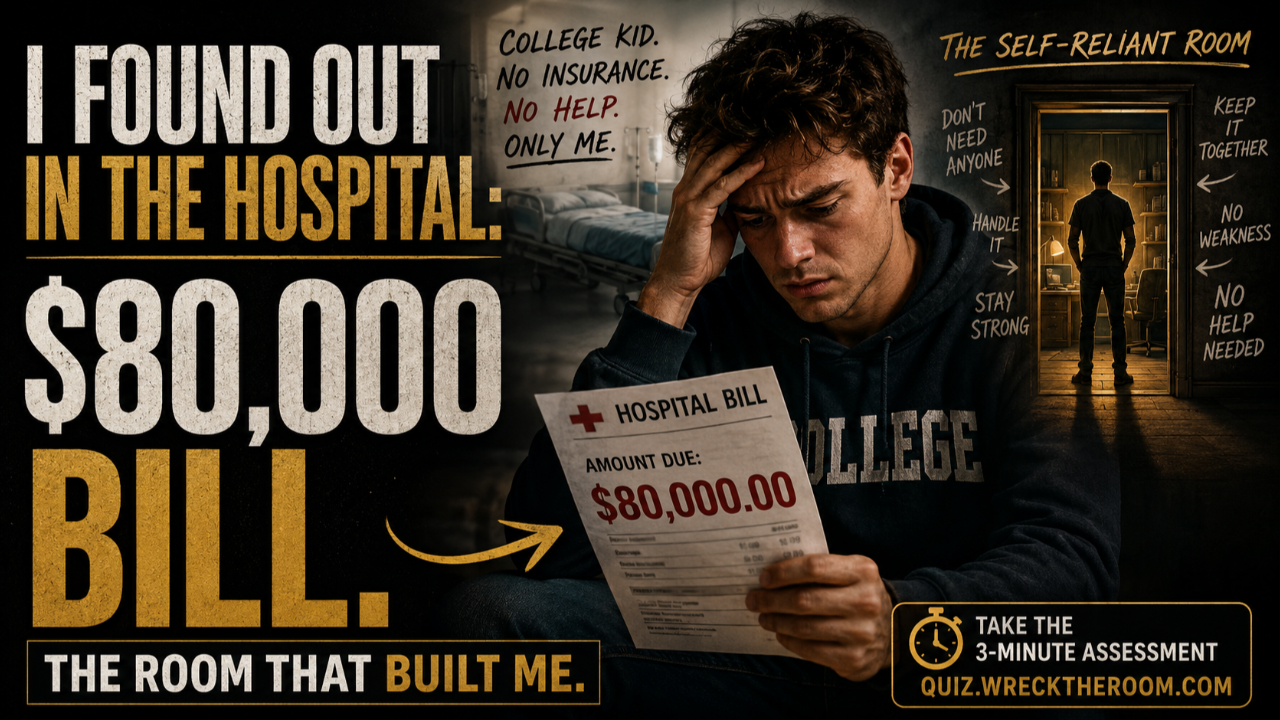
The $80,000 Bill That Made Me Grow Up
A hospital bill in college taught me that some people become responsible early because no one else takes responsibility for them.
I was in college when I found out I wasn’t on either parent’s health insurance.
I didn’t find out through a family conversation. Nobody sat me down and explained it. Nobody said, “Here’s what you need to know. Here’s how we’re going to handle this. You’re not alone.”
I found out because I was in the hospital.
I’d been fainting. Something was wrong enough that I needed medical care, and I remember the fear of the physical thing getting mixed with another kind of fear once the paperwork started to catch up with me.
Then came the bill.
Eighty thousand dollars.
I was a college kid staring at a number that didn’t feel real. It might as well have been written in another language. I didn’t have that kind of money. I didn’t have the kind of parents who stepped in and took over. I didn’t even fully understand how I’d ended up uncovered by both of them.
That was the part that stayed with me.
The bill was shocking.
The realization underneath it was worse.
Nobody had taken responsibility for me.
That’s a hard sentence to write, even now. It sounds harsher than I want it to sound, and at the same time, it’s the cleanest way I know to say what that moment felt like.
I was looking at an adult problem before I felt like an adult.
And the people who should’ve helped me carry it had somehow left me holding it alone.
So I did what I’d already started learning to do by then.
I figured it out.
I went to a professor who was connected to the hospital board and made my case. I advocated for myself. I explained the situation. I asked questions I didn’t know how to ask. I found a way through a system I never should’ve had to navigate alone at that age.
Eventually, the cost was reduced.
Then I had to ask my stepfather to help cover what remained because my mother wouldn’t ask him herself.
I can still feel the strange emotional math of that. Being the kid, but also being the one who had to manage the adults. Being scared, but needing to sound composed. Being overwhelmed, but knowing nobody was coming to handle it for me.
Moments like that build something in you.
They build competence. They build toughness. They build the ability to stay calm inside pressure and solve problems that would make other people freeze.
Those traits can become useful later.
Very useful.
Founders are often praised for exactly that. The ability to figure it out. The ability to carry pressure. The ability to walk into chaos and start organizing it. The ability to handle the thing nobody else knows how to handle.
People call it leadership.
Sometimes it is.
Sometimes it’s also an old survival pattern that got promoted.
That’s the part most high achievers don’t see right away. We think our self-reliance is just maturity. We think our ability to handle everything alone is strength. We think our discomfort with needing people is independence.
A lot of the time, those traits were built in moments when needing people didn’t feel safe.
The $80,000 bill didn’t just teach me how to advocate for myself.
It taught me that I’d better become the person who could fix things, because depending on someone else might leave me exposed.
That belief followed me.
It followed me into work, where I became the guy who could take responsibility without being asked. It followed me into business, where I learned to carry pressure quietly and turn uncertainty into action. It followed me into relationships, where receiving help could feel strangely uncomfortable because part of me had learned that needing help came with risk.
When you build an identity around self-reliance, people reward you for it.
They trust you.
They promote you.
They depend on you.
They call you strong.
And every compliment reinforces the room.
The room where you don’t need anyone.
The room where you handle it.
The room where you keep a steady face because falling apart would create a problem nobody else is prepared to solve.
That room can take you far.
It can also leave you lonely inside your own life.
Because eventually, the same identity that helped you survive starts deciding what you’re allowed to receive. Help feels suspicious. Rest feels irresponsible. Support feels like a debt. Vulnerability feels like giving someone access to a place they might abandon later.
So you keep handling things.
Even when you’re exhausted.
Even when people would help if you let them.
Even when the life you built is full of people who love you and are asking for a way in.
That’s what I’ve had to learn.
The kid with the hospital bill did an incredible job. He found a way. He protected himself. He became capable because capability was the only thing available to him.
I respect that kid deeply.
I also don’t want him running every room in my adult life.
There’s a difference between being capable and being unreachable.
There’s a difference between taking responsibility and carrying everything because you don’t trust anyone else to show up.
There’s a difference between strength and isolation that learned how to look impressive.
The work isn’t about becoming helpless. I have no interest in that. I still believe in agency. I still believe in responsibility. I still believe in being the kind of person who can handle hard things.
The work is learning how to let people stand next to you while you handle them.
That’s a different room.
And for some of us, it’s a terrifying one.
Because being helped requires a kind of trust that self-reliance never had to practice. You have to let someone see the part of you that doesn’t have the answer yet. You have to tell the truth before the problem is already solved. You have to risk being met instead of managed.
I’m still learning that.
A lot of founders are.
Because the same self-reliance that built the company can quietly keep everyone else at a distance. Your team. Your spouse. Your friends. Your kids. Even yourself.
You can become so used to being the responsible one that you forget responsibility was never supposed to mean being alone.
That $80,000 bill became one of the bricks in the room I lived in for years.
The Self-Reliant Room.
A room where needing help felt dangerous. A room where competence became armor. A room where being able to handle everything made it harder to receive anything.
I know that room because I lived in it for a long time.
Discover Which "Room" You're In.
Most people never realize the identity that built their success is quietly limiting what comes next.
Take the 3 Minute assessment to see where you’re operating from, and what it takes to evolve.