
The Song That Got Me Seen
Nov 10, 2026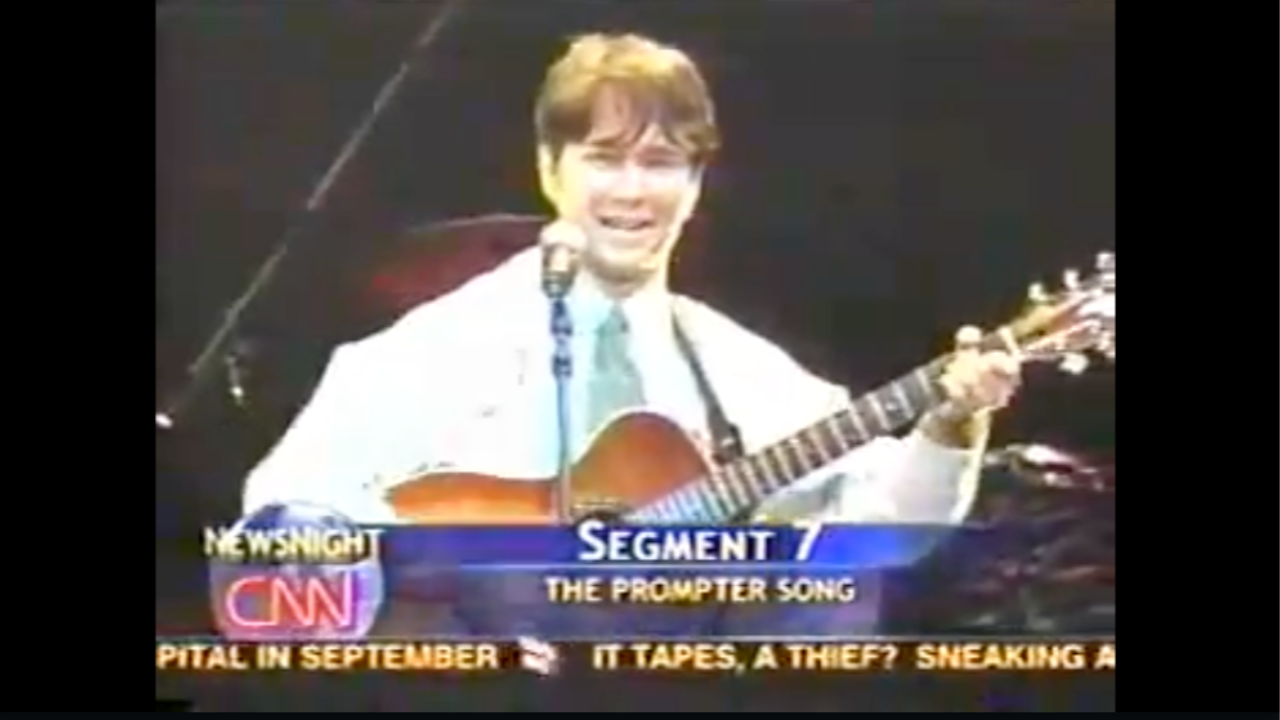
There was a talent competition at CNN called CNN Idol.
I know how that sounds.
A bunch of people who worked behind the scenes at a global news network got up and performed for each other, and somehow I decided the thing I should do was write a song about being a teleprompter operator.
That was my job at the time. I sat behind the machinery of the broadcast, invisible to the audience, feeding words to anchors who looked effortless on camera because someone like me was quietly keeping the whole thing moving.
So I wrote The Prompter Song.
It was ridiculous. It was also completely sincere.
I wanted the people behind the scenes to feel seen. Directors, technical directors, camera operators, audio people, producers, floor crew, prompter operators. The invisible machinery. The people who made the broadcast possible without ever being the face of it.
And when I performed it, something happened.
The room lit up.
People laughed. People sang along. People who had barely noticed me before suddenly knew who I was. The next day, the whole organization felt different around me. Anchors, executives, colleagues, people from departments I barely knew, they were stopping me, smiling, shaking my hand, telling me how much they loved it.
Then the president of CNN called me into his office.
He asked about me. What I wanted to do. Where I wanted to go. There was a job in New York I’d applied for, and he said he’d put in a good word.
Actually, the way I remember it, I first said no thank you like an idiot, walked back toward the control room, realized what had just happened, turned around, power-walked back across the building, and asked if he’d be willing to help.
He said it had already been done.
That moment felt incredible.
I won’t pretend it didn’t.
For a young guy trying to figure out who he was, working at CNN, playing music on the side, hoping someone would notice the part of him that felt bigger than the job title, it felt like oxygen.
People saw me.
And not just for doing my job. They saw the creative part. The funny part. The musical part. The part that could turn a room into something people felt together.
That’s a powerful thing when you’ve spent a lot of your life wondering where you belong.
It’s also dangerous.
Because moments like that teach lessons quietly.
Nobody sat me down and said, “Jody, this is how you earn attention now.”
No one needed to.
My nervous system learned it immediately.
Perform well and the room opens.
Create something clever and people value you.
Make people feel something and they remember your name.
That lesson followed me for years.
It followed me into music. Into business. Into speaking. Into rooms where I could feel myself scanning for the emotional temperature, wondering who needed what version of me. I got very good at reading people. I got very good at creating moments. I got very good at becoming useful, entertaining, impressive, or inspiring depending on what the room seemed to require.
And a lot of good came from that.
The ability to move a room is a gift. Creativity is a gift. Making people feel seen is a gift. I don’t regret writing that song. I’m proud of it.
I just didn’t understand the room it was helping me build.
The Performer’s Room doesn’t always feel painful at first. Sometimes it feels electric. Sometimes it feels like connection. Sometimes it feels like the first place you’ve ever been rewarded for being fully alive.
That’s why it’s so easy to move in.
The room gives you applause, opportunity, attention, and access. It gives you proof that you matter. For someone who has learned to associate being seen with being safe, that proof can become addictive.
Eventually, you stop noticing when the performance starts.
You become funny before anyone asks you to be funny.
You become impressive before anyone has decided you need to prove anything.
You turn every room into an audition without realizing you’re doing it.
That was the part I had to face later.
CNN Idol gave me one of the clearest early examples of my gift, and one of the clearest early examples of my pattern.
The gift was connection.
The pattern was performance for worth.
Those two things can live very close to each other. That’s what makes this work so subtle. The thing that makes you powerful can also become the thing that keeps you trapped when it’s being driven by an old wound.
For me, the wound was simple.
I wanted to be seen.
I wanted to matter.
I wanted people to feel something when I walked into the room instead of wondering whether I belonged there.
So I learned how to make rooms respond.
That can build a career.
It can build authority.
It can build a brand.
It can also make stillness feel terrifying.
Because when your identity gets built around creating a response, silence starts to feel like rejection. Ordinary moments start to feel insufficient. Being loved without performing can feel suspicious because a part of you still believes the performance is what made you lovable in the first place.
That’s what I wish I’d understood back then.
The song didn’t create the pattern. It revealed it.
It showed me how alive I felt when the room finally saw me. It showed me how quickly attention could turn into identity. It showed me how easy it is to confuse being valued for what you create with being loved for who you are.
There’s a difference.
And that difference matters.
Because a lot of high achievers are still trying to recreate their version of that room. The room where they first got noticed. The room where the teacher praised them, the coach trusted them, the boss promoted them, the client chose them, the audience clapped, the investor said yes.
That room felt like proof.
So they keep chasing it.
Another win. Another stage. Another launch. Another story to tell. Another reason for the world to say, “Look what you did.”
But at some point, achievement can’t answer the deeper question anymore.
It can prove you’re capable.
It can prove you’re talented.
It can prove you can deliver.
It can’t prove you’re safe to be loved without performing.
That’s the work I didn’t know I was being invited into.
Learning how to honor the gift without being ruled by the wound.
Learning how to create from truth instead of hunger.
Learning how to walk into a room without needing the room to decide my value.
I still love that CNN Idol moment. I love the absurdity of it. I love that a song about a teleprompter operator moved an entire organization. I love that creativity opened a door I couldn’t have opened any other way.
I just see it differently now.
It wasn’t only a career moment.
It was a mirror.
And I know that room because I lived in it for a long time.
Want to know which room you’re operating from right now?
Discover Which "Room" You're In.
Most people never realize the identity that built their success is quietly limiting what comes next.
Take the 3 Minute assessment to see where you’re operating from, and what it takes to evolve.